
Patrice Caine, Chairman and CEO of Thales, highlighted Artificial Intelligence as both a major cybersecurity challenge, accelerating attack speed and autonomy, and a crucial tool for defenders. He also warned about quantum computing's future threat to encrypted data. Thales introduced new AI-powered solutions like Luna 8 and CipherTrust DSPM at its Cyber Summit 2026 to combat these evolving threats.

The successful hosting of the 18th BRICS summit in New Delhi has provided a significant boost to the BJP, offering a timely opportunity to strengthen its narrative against the opposition ahead of crucial assembly elections next year. BJP sources highlight the BRICS grouping's strong condemnation of the Pahalgam terror attack and the consensus declaration as major diplomatic victories for the Modi government, countering criticisms of its foreign policy. The party plans to leverage these outcomes during its month-long Seva Sankalp campaign to connect with various sections of society.

Gaganyaan astronaut Prasanth Balakrishnan Nair stressed the critical importance of AI sovereignty for national cybersecurity, citing the increasing difficulty in distinguishing between real and fake content due to AI. Speaking at the Kerala Cyber Suraksha Summit, Nair highlighted that future conflicts and industries would involve a 'whole-of-nation approach,' blurring physical and digital boundaries. He urged greater awareness of digital threats and emphasised India's need to build on its technological capabilities in AI and cybersecurity, drawing parallels with the success of Chandrayaan-3. Other speakers also underscored the rising threat of cyberattacks and the potential for Kerala to contribute to national technology requirements.

India's IT Ministry sources state the country will not slow down its Artificial Intelligence development, distinguishing its focus on people-centric applications from global concerns over frontier models. The government acknowledges AI safety risks and is tightening incident reporting norms, with IT Minister Ashwini Vaishnaw emphasising regulation for user safety.
Uttar Pradesh Governor Anandiben Patel addressed AI Manthan 2.0, advocating for the comprehensive integration of Artificial Intelligence across all university subjects rather than as a standalone course. She urged universities to develop clear, time-bound AI roadmaps covering education, research, healthcare, and agriculture, emphasising indigenous AI development, employment creation, and the importance of "Safe and Trusted AI." The event also saw the formation of an AI Policy Advisory Group and an AI Implementation Group to drive these initiatives.

India and Australia have signed significant agreements covering civil nuclear energy, maritime security, and critical minerals, reinforcing their partnership's role in ensuring a peaceful Indo-Pacific. The pacts facilitate uranium supply from Australia to India and enhance cooperation in defence, cyber, and critical technologies.
Barclays Global Service Centre India MD & CEO Praveen Kumar has urged Indian banks to modernise their technology architecture and build AI-based defence systems to counter emerging cyber threats posed by AI tools.

Modi's comments on underlining the importance of ensuring the safety of seafarers came against the backdrop of growing anger in India over the killing of the three Indian crew members in a US military attack on a merchant ship off the coast of Oman last week.

The Beijing summit may have reduced immediate diplomatic uncertainty, but it did not resolve the deeper structural contest between the United States and China. That contest appears likely to define the coming decade, notes Varun Arya.

Karnataka Chief Minister announces a ban on social media for children under 16 and increased measures to prevent drug abuse in schools, colleges, and universities, alongside investments in education infrastructure and mental health support.

India supports dialogue and diplomacy and not war, Prime Minister Narendra Modi said at the Brazil, Russia, India, China, South Africa (BRICS) Summit in Kazan, Russia on Wednesday, in an unambiguous message calling for resolution of the Russia-Ukraine conflict through peaceful negotiations.
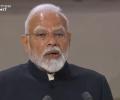
Prime Minister Narendra Modi advocated for a global framework for artificial intelligence (AI) based on open source, emphasizing the need for trust, transparency, and the elimination of biases. Co-chairing the AI Action Summit with French President Emmanuel Macron, Modi highlighted the transformative potential of AI across various domains, including politics, economics, security, and society. He stressed the importance of democratizing technology, addressing concerns about cyber security and disinformation, and developing quality data sets free from biases. Modi also acknowledged the need for open-source AI ecosystems to foster trust and transparency, while emphasizing the importance of localized technology for effectiveness and usefulness. Recognizing the potential of AI to improve health, education, and agriculture, Modi proposed pooling resources and talent to leverage the technology for sustainable development goals. Addressing concerns about job displacement, he emphasized that while the nature of work may evolve, technology creates new opportunities. Modi highlighted India's leadership in AI adoption and data privacy solutions, emphasizing the nation's readiness to share its expertise and contribute to an AI future that benefits all.

'Other sectors that manage the savings pools of Indians are giving tough competition to life insurance companies.'
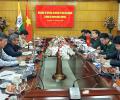
The 15th India-Vietnam Defence Dialogue signalled a move from routine talks to deeper cooperation, with new deals on submarine rescue and defence industry to support stability in the Indo-Pacific, notes Dr Rajaram Panda.
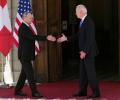
The summit probably fulfilled the expectations on both sides, but the bar of expectations was intentionally kept low, observes Ambassador M K Bhadrakumar.

AI-driven and deepfake-enabled cyberattacks are anticipated to become increasingly prevalent in 2025 with sectors like healthcare and finance most prone targets, according to a recent report. The India Cyber Threat Report 2025 by the Data Security Council of India (DSCI) and Seqrite, spotlighted the evolving tactics of cybercriminals and the rise of AI-driven attacks as a major concern. "Artificial Intelligence (AI) will be used to develop highly sophisticated phishing campaigns utilising deepfake technology and personalised attack vectors, making them harder to detect.
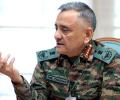
Chief of Defence Staff General Anil Chauhan on Saturday said India's Operation Sindoor has drawn a 'new red line' of intolerance against terror, and expressed hope that the military action has brought 'some lessons for our adversary also'.

'Hacking of an ID or an account will have the same impact on a user in a city and one in a small town.' 'Security is like a railroad, you create it to last for every customer.'

'Its nature changes, new types of jobs are created.' 'We need to invest in skilling and re-skilling our people for an AI-driven future,' Prime Minister Narendra Modi said in his opening speech at the AI Action Summit in Paris, co-hosted by India.

Nearly 22 per cent of the cyber attacks which took place in the country last year were on the banking sector.

'While on the one hand, terrorism continues to be a serious threat to global peace and security, on the other hand, areas such as cyber, maritime and space, are emerging as new theatres of conflict'

Though chief executive officers from Google, Yahoo and Facebook have declined to attend the summit, the Apple CEO Tim Cook will address the meeting during which he will announce his intent to fold the government's cyber security recommendations into its own cyber strategy.

Prime Minister Narendra Modi will participate in the first in-person summit of the Quad leaders in Washington on September 24 that is expected to broadly focus on contemporary global challenges including ways to ensure a free, open and inclusive Indo-Pacific.

Pitching for 'zero tolerance" against terrorism, Prime Minister Narendra Modi on Tuesday told leaders of the five-nation grouping BRICS that the "choices" they make now will shape the future of the world at large.

United States President Barack Obama and his Chinese counterpart Xi Jinping on Saturday agreed to work together in a "pragmatic way" to resolve crucial cyber security issues that have spiralled tensions between the two nations.
State-owned Life Insurance Corporation (LIC) is not keen on a composite license but it is looking to buy less than 50 per cent stake in a standalone health insurance company to enter the health insurance segment such that they have a say in the management of the company, without having to run the company, sources in the know said. "LIC doesn't need a composite licence. "Even if it is introduced, they will not opt for it.
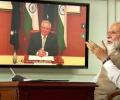
The Mutual Logistics Support Agreement will allow militaries of the two countries to use each other's bases for repair and replenishment of supplies besides facilitating scaling up of overall defence cooperation.

Internet threats have increased dramatically in the recent time affecting 431 million adult globally or 14 adult victims every second.

India has told the United Nations that governance of cyber space should be democratic and transparent and cannot be managed as a "private property".

Prime Minister Narendra Modi on Sunday made a fresh push for reforms in global institutions, including the United Nations, asserting that the world's 'new realities' should be reflected in 'new global structure' as it is nature's law that those who don't change with times lose their relevance.

Terrorism, trade and South China Sea dispute are expected to dominate discussions at the 13th ASEAN-India Summit likely to begin later today with Prime Minister Narendra Modi and other Southeast Asian leaders reviewing the Association of Southeast Asian Nations-India cooperation and charting out its future direction.

Modi attended the 20th ASEAN-India Summit in Jakarta. Secretary-General of ASEAN Dr Kao Kim Hourn also attended the summit.

In his opening remarks at the G20 Leaders' Summit at the Bharat Mandapam in New Delhi, Modi said the 21st century is a time of giving new direction to the world.

Leaders of the powerful G7 grouping and its five partner countries, including India, have said that they are committed to open public debate and the free flow of information online and offline while guarding the freedom, independence and diversity of civil society actors.

Prime Minister Narendra Modi said some countries still use terrorism as "an instrument of state policy" and the world must act against radicalisation without any political consideration

The two leaders conversed on the sidelines of the Group of 20 summit here for ninety minutes and worked to clarify gaps in negotiations over on the Syrian crisis.
The accelerating pace of digitalisation, fuelled by the COVID-19 pandemic, has led to a record-breaking year for cybercrime with ransomware attacks rising 151 per cent in 2021, and an average of 270 cyberattacks per organisation being faced, a new study showed on Tuesday. The World Economic Forum's 'Global Cybersecurity Outlook 2022', released during its online Davos Agenda summit, further said that each successful cyber breach cost a company $3.6 million (nearly Rs 27 crore) last year, while the average share price of the hacked company underperformed NASDAQ by nearly 3 per cent even six months after the event in case of the breach becoming public. The WEF said the global digital economy surged on the back of the COVID-19 pandemic, but so has cybercrime and nearly 80 per cent of cyber leaders now consider ransomware a 'danger' and 'threat' to public safety.

Informing the world leaders of measures taken by him, Modi said India will continue to accord a high national priority to nuclear security through strong institutional framework, independent regulatory agency and trained and specialised manpower.
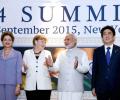
Hosting a summit of leaders of Germany, Japan and Brazil under the G-4 format, the PM said the UNSC "must include the world's largest democracies, major locomotives of the global economy, and voices from all the major continents" to carry "greater credibility and legitimacy".

Leaders of the United States, India, Australia and Japan did discuss the 'challenge' posed by China during the first meeting of the Quad, and they made clear that none of them have any 'illusions' about Beijing, US National Security Advisor Jake Sullivan has said.
